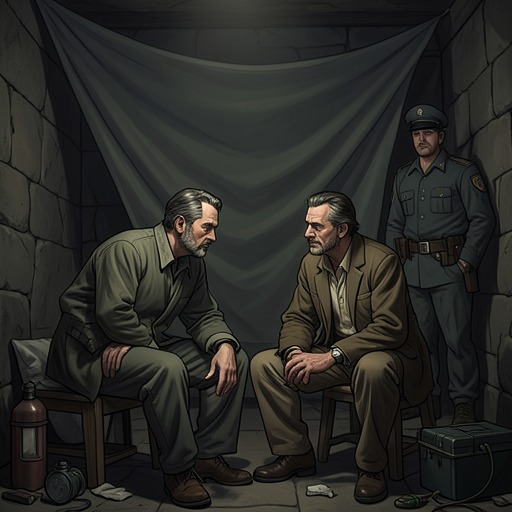
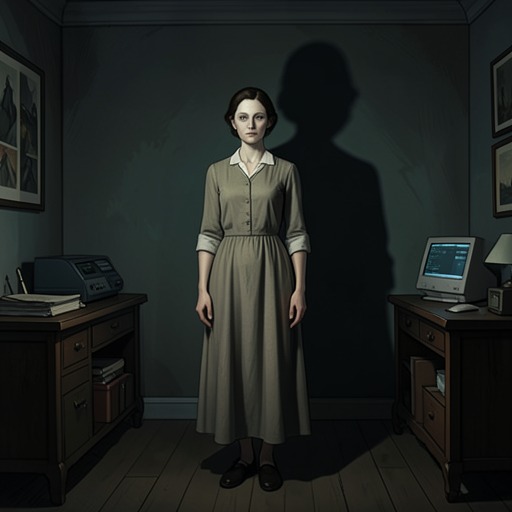
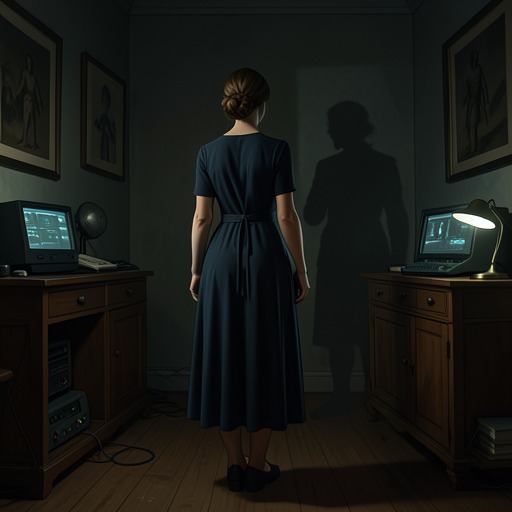
Irena
Kiss of the Spider WomanIrena is the refugee at the center of a film story Molina tells Valentin: an art student from the Carpathian Mountains whose fear of a family legend turns desire into danger. Her story moves from an encounter with an architect in Central Park to a killing and a release at the zoo, ending with Irena and the panther dead. The tale’s decisive uncertainty is whether the legend explains her violence or gives it a shape that the people around her cannot safely dismiss.
Identity and Introduction
Irena explains that she studied fine arts in Budapest and left for New York when the war began. When the architect asks whether she misses her city, she corrects his assumption: she comes not from a city but from the Carpathian Mountains. The distinction shifts her from the familiar figure of a displaced European into a landscape of dark forests, winter hunger, and village fear. Her origin is not merely biographical; it is where the story locates the legend that governs her sense of herself.
The first meeting takes place while Irena is drawing. A page comes loose as she fixes her hair and the wind carries it away; the architect runs after it and returns it with an apology. He learns that she is a foreigner from her accent, and she agrees to come back and draw the following afternoon, as she has done on recent sunny days. The architect later leaves his studio for the zoo across from it in Central Park, drawn there by an impulse he cannot explain to his assistant. The repeated visits to draw and to watch the panther establish two parallel attachments: one to the architect, and one to the animal.
The Panther-Woman Legend
Irena has lived with a childhood fear that she may descend from the panther women said to inhabit her mountain homeland. In the story she recounts, a soldier dies and a fellow Crusader discovers that the soldier’s wife murdered him. The woman escapes through snow; her tracks change from a woman’s footprints to a panther’s near the forest. The Crusader finds her in darkness, where her green eyes shine, and makes the sign of the cross with sword and dagger. She returns to human form, apparently hypnotized, while beasts approach, drawn by her scent. The Crusader escapes and tells the village what he has seen.
The legend claims that the panther women survived in hiding, appearing ordinary until a man kisses one of them and she becomes a savage beast. Irena does not know whether she belongs to this lineage; she knows that the stories terrified her as a girl and that she has never escaped the possibility. That uncertainty makes intimacy feel like a test with catastrophic stakes. The story gives no independent proof of the legend before its final violence, so fear, inherited narrative, and apparent transformation remain entangled rather than neatly separated.
Desire, Treatment, and Betrayal
Irena confides her fear to the Psychiatrist, who tries to reassure her by presenting her as an enchanting, ordinary woman. His reassurance is compromised by his own desire: he hopes to kiss her and allows that desire to guide his supposed treatment. Irena accepts his conclusion that she is normal, leaves satisfied, and hurries to the Architect’s studio, apparently resolved to give herself to her husband that night. The change in her mood is immediate and consequential: the prospect of intimacy seems possible just as she discovers a scene she cannot interpret.
At the studio, she finds the Architect and his young assistant alone, holding hands and talking. Whether the gesture is friendly or signifies something more is left uncertain; neither notices Irena at the doorway. Her arrival interrupts the confidence with which she had approached her husband, and the narration itself becomes indistinct at this point. Later, after an incident at the pool, the assistant calls the Architect away to the women’s hotel and then the police station, leaving the Psychiatrist at the Architect’s house. When Irena finds the Psychiatrist there at night, she feels both repulsion and desire toward him. She throws herself into his arms because she feels abandoned and forsaken by her husband. He reads the gesture as sexual interest and again imagines that a kiss, or more, will cure her fear.
Killing and Ending
The Psychiatrist kisses Irena, and they embrace. She then slips free and looks at him with green eyes that seem to hold desire and hatred together. She retreats to a dark corner beyond the table lamp’s reach and drops to the floor. The transformation follows: a panther attacks before the Psychiatrist can defend himself with the fireplace poker. It tears open his throat, then claws his face—the cheeks and mouth he had kissed moments earlier. The assistant and the Architect, already away from the house, try to telephone the Psychiatrist and warn him, but the warning comes too late. The scene converts his attempt to master Irena’s fear through his own desire into the very violence he believed he could prevent.
Earlier that afternoon, Irena had watched the zoo keeper feed the animals. He left his key in the cage lock, and she took it when he was not looking. After the killing, she returns at night with the keys in her hand, walking like a sleepwalker. The panther wakes at her scent. Irena opens the lock, slides back the bolt, and releases him as the others approach with police cars sounding through the nearly deserted streets. Her expression is described as strange and tragic, yet excited; she seems almost transported as the panther leaps from the cage and knocks her down. He escapes into the park and across the road, where a police car hits and kills him.
The Architect finds Irena on the cobblestones at the place where they first met. Her face has been disfigured by the panther’s claw, and she is dead. The Architect and his assistant walk away arm in arm, trying to forget the spectacle. The ending binds Irena’s first meeting and last scene to the same ground, but gives the return no reconciliation: the animal she watched, feared, and freed is dead, and so is she. In Molina’s telling, the panther story is both a melodrama of desire and a test of how much can be known about another person when legend, fear, and violence occupy the same explanation.